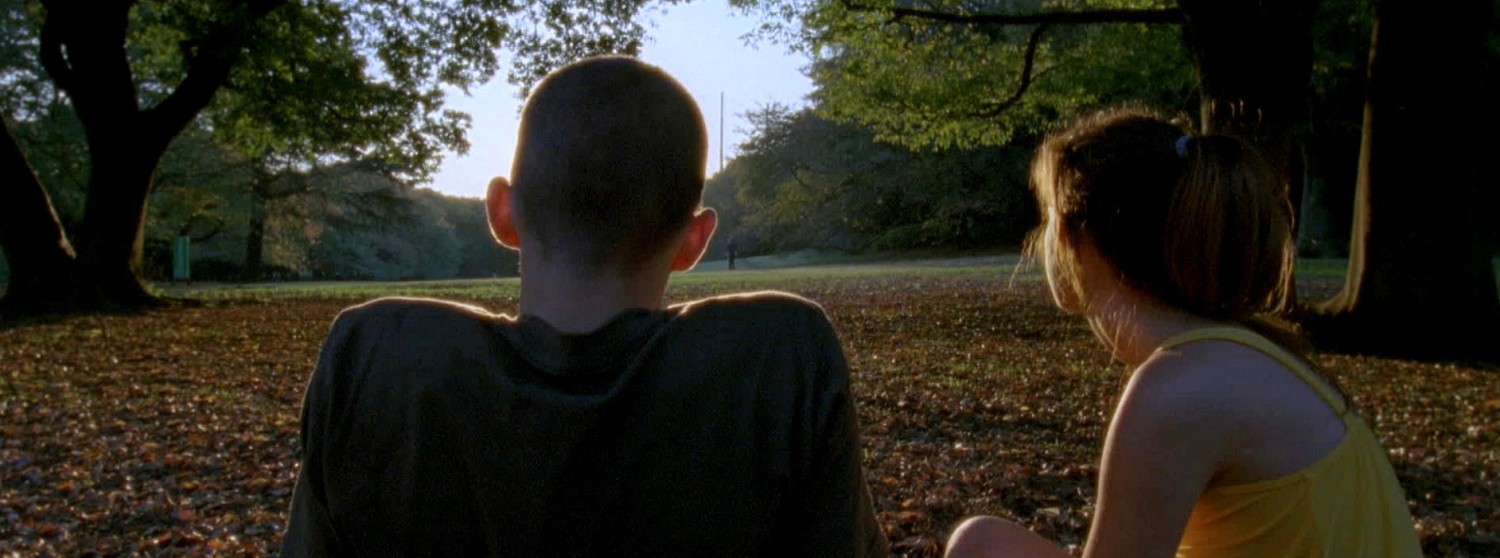

The first David Lynch film I saw was “The Straight Story,” which is one of the most achingly beautiful films ever made. I was quite young when I first saw it and thought, ‘I wonder what else this guy has made?’ So I rented the film he made next, “Mulholland Dr.”, and it disturbed me like few films ever have. I had no idea what to make of it, but it refused to leave my mind. In college, I revisited the film, and all of a sudden, it made perfect sense to me—in the way that only cinema or dreams can. I was exhilarated, and couldn’t wait to see his next audacious picture, “INLAND EMPIRE.”
Lynch was due to attend a signing for his new book, Catching the Big Fish, the day before he participated in a Q&A for the film at the Music Box Theatre. I sat for hours at the book store until Lynch came in through the front door and walked directly up to me. I shook his hand and said, “Thank you so much for being here.” “My pleasure,” he laughed. At that event, he gave some unforgettable answers to attendees puzzled by his work, most notably, “The way to follow my films is to follow the emotion. Because if you follow the buttermilk, you’ll end up going to the dairy.”
In the years that followed, “Mulholland Dr.” became my all-time favorite film and Lynch became my favorite living filmmaker. I adore his masterpieces “Eraserhead,” “The Elephant Man” and “Twin Peaks: The Return,” the latter of which will forever remain his magnum opus. As we were engulfed in so much numbing noise from the new and soon-to-be-returning administration in 2017, Lynch reminded us with “The Return” to slow down, take a deep breath and pay attention to what would otherwise be overlooked. After becoming smitten with Rebecca, the woman who would become my wife, upon meeting her by chance on a radio show, I got up the courage to ask her out by casually suggesting, “Want to talk more about ‘Twin Peaks’?”
We later received a tour of the Laura Palmer house courtesy of the great Mary Reber, dressed as characters from “The Return” for our last pre-COVID gathering (I was Wally Brando), and for my unofficial bachelor party, I attended every day of Daniel Knox’s unmatched Lynch retrospective at the Music Box. During the uncertain days of the pandemic, the director comforted us with the reliability of his tirelessly optimistic daily weather reports. To say that I am devastated by the news of his passing at age 78 would be an understatement, but there is no question that his spirit will live on in the countless people he transformed through his awe-inspiring artistry. As John Merrick’s mother reminds us in the haunting final moments of “Elephant Man,” “The stream flows, the wind blows, the cloud fleets, the heart beats. Nothing will die.”
On what would’ve been his 79th birthday, here are ten extraordinary artists I had the privilege of interviewing over the years who spoke with me about their experiences with Lynch. Click on each bolded name, and you’ll be directed to our full conversation…
“I have worked with a lot of directors now, and I only allow my work to be optioned for a movie when I think it could be something great because I got spoiled by beginning with Lynch. The job of the writer is to give the director the vision that she or he sees and wants to put into a visual form, and when you work with someone like Lynch, you know that you’re going to get more bang for your buck. It’s going to go to another level and be elevated, in a way, so you put your whole self into it and you write whatever you want.”—Barry Gifford, author of Wild at Heart and co-writer of “Lost Highway”
“The less you actually show slashing, the scarier it is. It’s certainly an old principle of filmmaking and film editing that many great editors understand. It’s not anything I’ve invented. I just clued into it very early on in the process, because David’s films really demand time for people to digest while they’re watching. There’s a lot you don’t quite understand. You’ll watch his films and think, ‘Wow, I really like that sex scene, but what the heck is going on here?’, or, ‘Oh my god! She’s chopped up in a video? Did I really see that?’ You have to make sense out of it. As an editor, you need to respect the audience but you also kind of own them, and I don’t mean this to sound manipulative. You want people to enter the dream. That’s the whole idea.”—Mary Sweeney, Lynch’s ex-wife and frequent collaborator
“I started talking him through these little moments with his character, William. I had part of him in my mind when I wrote this role, not because the character has dementia or because he’s old—it’s because he’s really sexy, dad! [laughs]—no, it’s because he has this gentleness and innocence and a pure golly gee willikers attitude that my father also possesses, as well as a secrecy and humanity. As I talked, he got tears in his eyes. When he answered a question that I asked his character, I said, ‘That’s William. Will you play him?’ He said, ‘Yeah, can I have a sore?’ I said, ‘Where do you want it?’ and he said, ‘On my face.’ I said, ‘Not an open sore, you can have a place that you’ve rubbed too much because you have dementia.’ And he said, ‘Okay.’”—Jennifer Lynch, Lynch’s daughter, who had planned on casting him in her film, “A Fall from Grace”
“My French accent would’ve been transparently fake and I thought it would be easier to disguise my speech with the Japanese. I assumed I’d have the help of my voice being electronically altered. At the last minute, I realized that they had no plans to do that, so I just jumped in and did what I could. Successful directors would come in as the guest directors for each week, and nothing was told to them [about me] because that was important to David for some reason. I would love to ask him why. He didn’t want anyone to know—not my family, not the cast or crew. So I respected that as much as I could until my sister started having asthma attacks because she thought I had been fired.”—Piper Laurie, who played Catherine Martell and posed as Fumio Yamaguchi on “Twin Peaks”
“It was a real gift. I only got to spend an hour or so with David. We shot the scene exactly the way it was written and there was very little discussion of it. I just had to show up prepared, we shot it in no time and then it was over. I would’ve loved to have spent more time there.”—Michael Cera, who played Wally Brando on “Twin Peaks: The Return”
“As an actor, you have to do something over and over again, but it has to feel like the first time during each take, and it’s amazing when you learn about how many years they spent making ‘Eraserhead.’ That sense of newness is something that I experienced working with David. His curiosity and that childlike way of looking at things afresh was really inspiring. I felt tuned into the fact that he had chosen me for specific reasons and believed that I was right for the role. He wanted me to explore, make unexpected choices, be spontaneous and present in the moment, welcome surprises and the unknown and be open to everything that is possible like he is.”—George Griffith, who played Ray Monroe on “Twin Peaks: The Return”
“After the pilot was rejected, the project languished for fifteen months. The French came along, StudioCanal, and said, ‘We’ll put up money to finish this as a feature film.’ David said, ‘I have no ideas for how to do that,’ so it just went for months and months. David is a transcendental meditator. So am I and so is everybody in the studio. We have a 5:30pm group meditation in the studio, while David meditates downstairs in his office. I was able to participate in these daily sessions after David paid for me and my family to get initiated in 2000. Meditating has opened up my clarity and I think more clearly now. It relieves stress, and is really good.”—John Neff, Lynch’s frequent collaborator
“David’s genius is in knowing intuitively, as you said, what will work together, and I feel that the TV shows we watch today are very much influenced by what David did with ‘Twin Peaks.’ David was making cinematic television, and he started that trend. I’m also not just grateful but proud and really honored to have been the Latina in the pivotal moment of such an iconic film. Having me singing with one of the film’s stars, Laura Harring, who is also a Latina, in the audience was this marriage of the demographic that everybody wants to tap into right now. David maybe wasn’t even aware of it, but he was intuitively doing it back in the ’90s.”—Rebekah Del Rio, who sang “Llorando” in “Mulholland Dr.” and “No Stars” on “Twin Peaks: The Return”
“David was touring with ‘Inland Empire,’ and the Music Box was on the list of venues he’d be visiting. I submitted a piece of music I had written, they accepted it and I played it on the Music Box organ for two shows. The Music Box let me do it on the condition that I project the second show of the night so that another projectionist wouldn’t have to stay late. I went to dinner with David in between the two shows. It was me, him, his wife and some people who work at the theater. I sat across from him and he had ravioli. He talked with his hands a lot, and for some reason, there are two unimportant things that stuck in my mind from that dinner. He got a phone call from Justin Theroux who had just sold his script for ‘Tropic Thunder’ to Miramax, and David told him to be mindful of the Weinsteins’ scissors. I also remember him telling me that the Italian dubbing of ‘Blue Velvet’ had turned the dialogue into straight pornography. He could’ve just been telling me a tale.”—Daniel Knox, programmer of the Lynch retrospective at Chicago’s Music Box Theatre
“David and Mark created a piece of art that used the passage of time as a character, and in ‘The Return,’ David opened it all up and then he made it cosmic. He truly did. You could talk about it for hours and hours and not begin to encompass what it all meant. It’s too huge. There are so many ways to interpret every image. I think Part 8, the episode involving the atomic bomb, is the most incredible thing that I have ever seen on film, from start to finish. When I am in the presence of David, whether I’m being directed by him or listening to him or watching his work, I’m in good hands and I just take the ride. Right now, he’s doing daily weather reports on his YouTube channel, and I am a faithful viewer of them. Every day, I have to tune into the latest video. Those reports are getting me through this year because as long as there’s David, I feel like it’s going to be okay, regardless of what happens.”—Wendy Robie, who played Nadine Hurley on “Twin Peaks” and “Twin Peaks: The Return.”
Thank you, David. In heaven and on earth, everything is immeasurably finer because of you.
To participate in a worldwide ten-minute group meditation at 2pm CT today at the invitation of David’s children, you can either do it on your own or join this Zoom link from the David Lynch Foundation.
 Indie Outlook