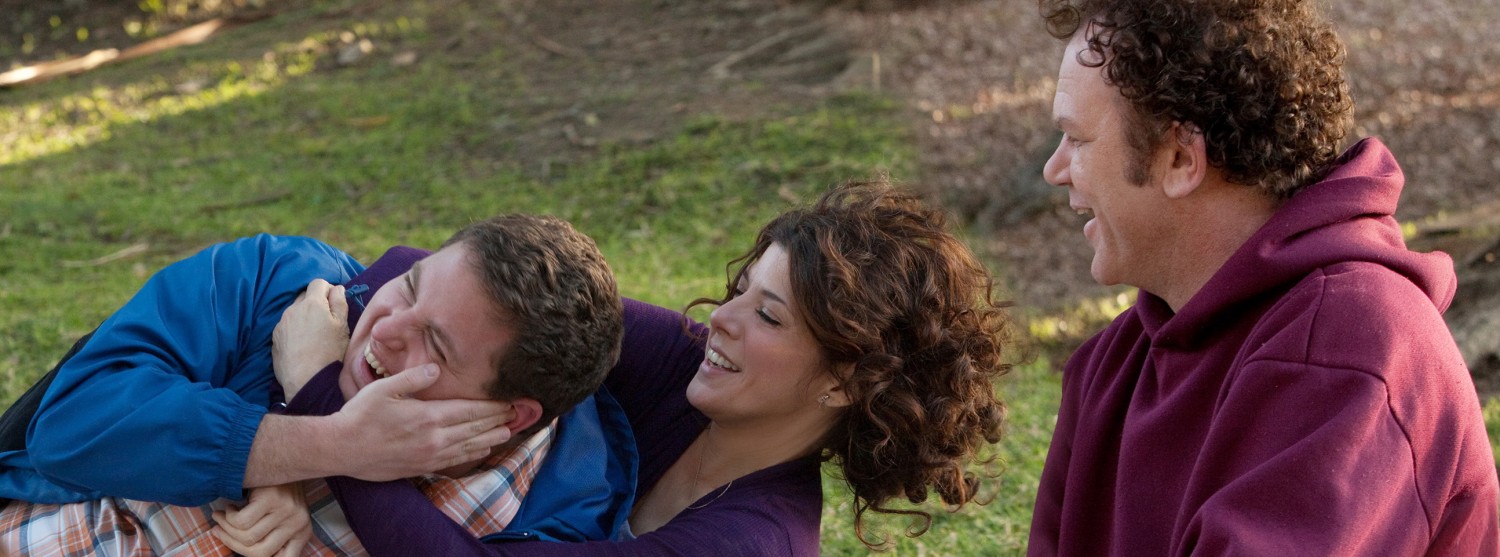

Even during my current writing hiatus, no force on earth could prevent me from interviewing Crispin Glover during his long-awaited return to Chicago. Whenever his name appears in the credits of a film, it causes me to perk up. His performances over the past several decades have been endlessly surprising, entertaining and sometimes explosively funny. Yes, he is still best known to mainstream audiences as Marty McFly’s father in the now 40-year-old classic, “Back to the Future,” but he is every bit as memorable in such pictures as “River’s Edge,” “Wild at Heart,” “The Doors,” “Willard,” and perhaps my personal favorite, Michael Almereyda’s “Twister” (no, not the one about storm chasers).
For the past two decades, Glover has proven to be every bit as adventurous behind the camera. I first interviewed him for my college paper in 2007 about his galvanizing and oddly touching sophomore directorial effort, “It Is Fine. EVERYTHING IS FINE.”, which was written by its star, Steven C. Stewart, a man with cerebral palsy. Stewart also appeared in Glover’s 2005 directorial debut, “What Is It?”, which features a cast of actors with Down syndrome and remains unseen by me. That’s because the only way to see Glover’s work as a director is when he goes on tour with them. Not only does he show up in person for the screenings themselves—which include a Q&A, book signing and surreal slideshow presentation, wherein Glover theatrically reads from self-authored books—he is present for the press screenings as well. I’ll never forget watching Glover deliver his larger-than-life slideshow performance in the tiny Lake Street screening room before an audience that included Roger Ebert and Jonathan Rosenbaum.
Earlier this month, Glover traveled to Chicago’s Music Box Theatre for the press screening of his latest directorial work, “No! YOU’RE WRONG. or: Spooky Action at a Distance.” The filmmaker stars in the picture alongside his father, veteran actor Bruce Glover, whose credits included “Diamonds are Forever,” “Chinatown,” and “Ghost World.” Bruce’s death at age 92 this past March brings an added layer of poignance to watching him and his son trade off roles as the film chronicles various generations of the deeply troubled Muldoon family. Some of the most recognizable names in the film are among the crew, including dialect coach Fionnula Flanagan (who co-stars with Glover in the new Kafka-inspired thriller, “Mr. K”) and Sean Ono Lennon—son of Yoko and John—who is credited as a musician on the soundtrack and the voice of the film’s grotesque “dream toddler” puppet.
“No! YOU’RE WRONG. or: Spooky Action at a Distance” is as bizarre, entrancing, amusing and haunting as one would expect from an artist like Glover, and is sure to make for an unforgettable audience experience when he returns for its Chicago premiere this Thursday, October 23rd, at the Music Box. After performing an abbreviated version of his slideshow and giving me a signed copy of his book, Rat Catching, Glover spoke with me about his fascinating work and his unconventional approach to distribution. We also discussed the film he had always wanted to make with the late, great David Lynch, and the upcoming picture he recently filmed in nearby Galena, Illinois.
When we last spoke 18 years ago, you told me of how your intention with “It Is Fine. EVERYTHING IS FINE.” was to subvert the patronizing tropes so often associated with people who have conditions like cerebral palsy.
I’m very proud of that film. I co-directed it with David Brothers, and that was a very good collaboration. The script had been written from the perspective of somebody who had lived that life. I knew as soon as I first read it in 1986 that I would have to be the person to essentially fund it in order to get it made. I just knew it would not be possible to get funding for it. It had to be directed and produced sensitively because for many people, it goes into territory that’s not acceptable, certainly in a corporate sense. But to me, the film is beautiful in terms of the psychology that Steve explores in it.
The term often used these days is “outsider artist” for someone who in previous years would have been called a “folk artist,” and Steve really was working properly in that realm. He lived apart from others. It’s not that he wasn’t intelligent. He was. Yet when some people see a person with cerebral palsy, they might think they have some kind of developmental disability. That is true in some cases, but Steve was of normal intelligence. Yet he also was isolated for a lot of his life, so the film can have a naïveté to it at times.
I love that film, and in fact, I wrote my first directorial effort, “What Is It?”, after I already knew I wanted to make Steve’s film. “What Is It?” is like a thesis statement. It was informed by my knowing Steve and his screenplay for many years before that. Then I put Steve in “What Is It?” to make his film a sequel, which was helpful in terms of marketing. Knowing Steve also helped inform me about certain aspects of the disability community. I wish more people saw “It is Fine. EVERYTHING IS FINE.”, and at some point, I’ll start touring with that film again. I’m proud of all the films in different ways.
To what extent did your relationship with your father fuel this new project and the dynamics that you share onscreen?
The film was developed for myself and my father to act in together, but it came from something else. There was a different screenplay I had started developing a number of years before this one that didn’t end up getting made. It was to be for an actress I knew who’s very good at character work. I conceptualized something for her and I to act in together where we would play multiple characters. For various reasons, the film didn’t happen, although I liked the idea of it very much. I still like the idea of it, but I realized I should do something like that for myself and my father. Originally, it was just supposed to be he and I in the film. There were going to be no other actors in it, and any other characters would be represented by shadow figures, silhouettes, voices on telephones, that kind of thing.
I was also interested in a certain kind of story structure. I’d read a very good book about the various steps in the “Hero’s Journey,” which had been popularized by Joseph Campbell. This book was very valuable in how it went into great detail about the A character and the B character, or rather, the protagonist with the old world romantic interest, and the new world romantic interest. Joseph Campbell didn’t write The Hero with a Thousand Faces for writers, but it is, in fact, the best book for people who want to write. I hadn’t realized how important the old world and new world romantic interests were until I read this other guy’s book that was riffing on Campbell’s work. So I started writing those female romantic interests into my script for “No! YOU’RE WRONG.”, and as soon as I did, I realized that they had to be flesh and blood characters. Also, once I got into the technical aspects of shooting, making silhouette characters for an entire film proved to be too difficult.
After a number of years of shooting and editing the footage, I realized that I needed to do something else with it, and that’s when the “Spooky Action at a Distance” material came into it. I don’t like to say too much about the film because I want people to be open to interpreting it in different ways. I love surrealism—“capital S” surrealism, meaning the surrealists of the ’20s and ’30s, and “small s” surrealism, which is contemporary surrealism. But because I’m aware of it and I always admire it, I recognize that there are ways in which my film is constructed—and even, I’ll admit, mistakes in my initial way of identifying the characters—that has led to confusion. Then I realized how these mistakes could be beneficial if I leaned into them. The storyline is hyper-clear to me, even in its poetic interpretation onscreen, but there’s no way anyone else could view it that clearly. My hope is that audiences will get something from the film, put it together in their own way, and have some kind of genuine experience with it.
Why do you make the added effort to attend the press screenings of your films?
Because this is the way that I have distributed them. When I present these films, I’ll have a book signing afterwards, and somebody will ask me, “Will this get distributed?” [laughs] This is how I’ve been distributing my films for the past 20 years, since 2005. The first time I ever performed the slideshow was in 1993, and in the original show, I presented eight books. As I’ve done it over the years, some of the books repeat and some are different. People have always liked the show, and right now, I’m figuring out the new slideshow for “No! YOU’RE WRONG.” that the audience will see me perform at the Music Box. I only did three books for you and the other press in attendance today. I’ve never put the show on camera because if I did, it wouldn’t be proper to tour with it. I get more and more concerned about people trying to pirate it. I will always protect the show quite fiercely.
The Music Box is a perfect place for this kind of art.
Oh yeah. My favorite venues to play at are the vaudeville era venues. The Music Box was built at the very tail end of it in 1929. It was initially built to be a silent movie house, and was able to be upgraded for sound immediately before it opened. As a performer, I can tell the difference if something was designed in the vaudeville era. It’s far better. Modern contemporary stages are terrible. I’ll perform anywhere on these tours—I’ve performed on boxes or what have you—but ideally, I like to be on a proscenium arch stage. The Music Box does not have a deep stage, but it’s great. My favorite show I’ve ever done was the first one I did here in 2005 for “What Is It?” It was a sold-out show with a great live audience.
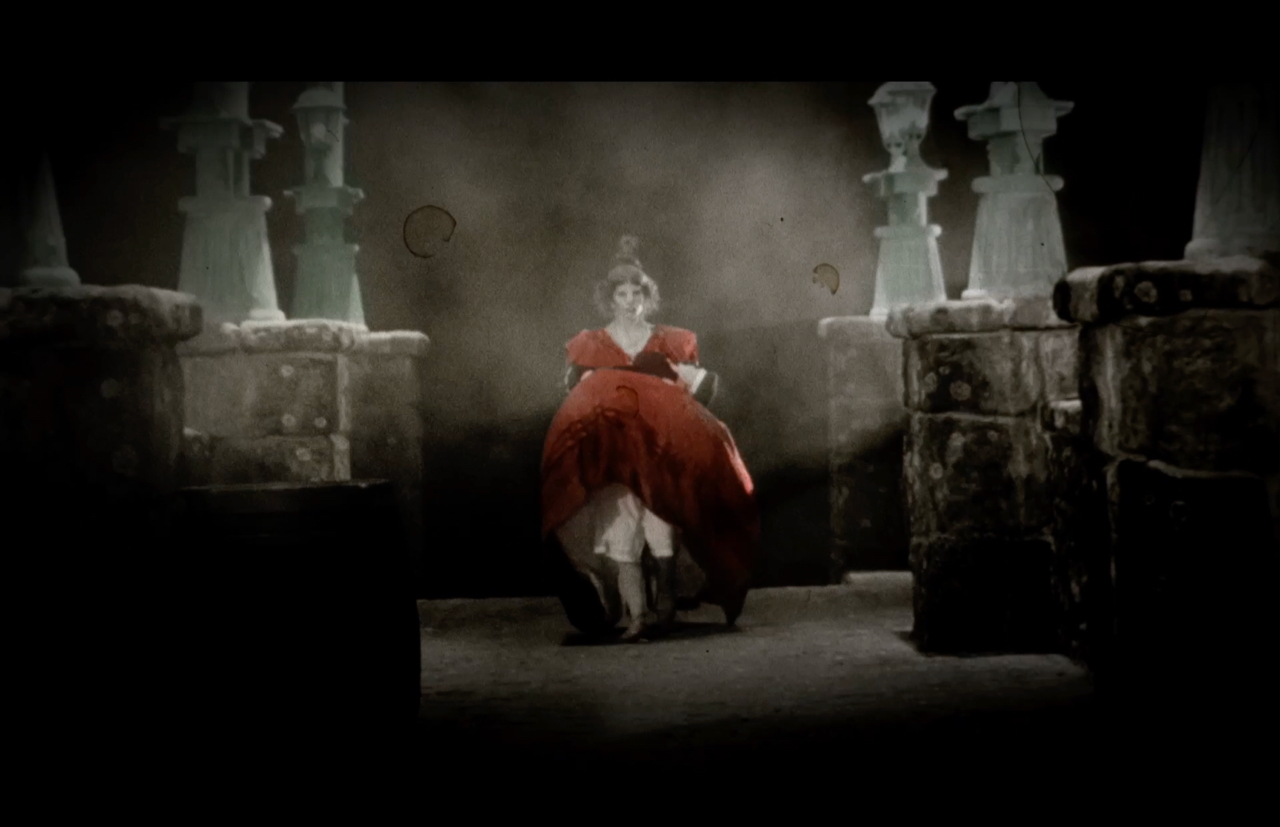
The audiences who come here are open to having new experiences. I saw David Lynch present “Inland Empire” here in January of 2007, and the joy of pure creation he displayed in that film I sense in your directorial work as well, even down to your striking use of color against the black and white, which is reminiscent of the silent era.
The color correction took two years by itself. This film has taken so, so long to make. I’m not happy about that, but that’s what had to happen. Lynch had a book come out, Room to Dream, where the first half of each chapter was a biography, and the other half was an autobiography. In one of the autobiographical sections, he wrote that he produced my first film, “What Is It?” Well, the thing is, he did, though the proper title would be executive producer. But there was a mix up. Lynch had agreed to executive produce “It Is Mine,” which would be the eventual third part of my “It” trilogy. He agreed to executive produce that for me to direct, which was great. I went to one of the go-to production companies in the ’90s for so-called independent film, and they were interested. They knew David Lynch was executive producing, and I had a number of actors with a certain kind of name value who were interested. But after a number of meetings and conversations, they were concerned about funding a film where a majority of the characters would be played by actors with Down syndrome. So it was decided that I should write a short screenplay to promote this as a viable idea. This wasn’t something I talked with David Lynch about.
I wrote a 20-something page screenplay called “What Is It?”, where I decided I’d have all of the characters be played by actors with Down syndrome, as opposed to most of them, because I wanted to prove that this was viable. We shot those pages in four days, and I taught myself how to edit it on Adobe Premiere. This was so long ago, around 1995 or 1996, so I taught myself with a manual. I actually was a digital pioneer in editing because I was on the phone with Adobe Premiere getting technical support when you used to have to call long distance. At the time, QuickTime, the Macintosh Apple software, would go out of sync after a certain number of seconds, and Adobe knew about the situation. I told their tech support that I was doing a long form feature film, and they replied, “Oh yeah, there’s some other guy in Idaho who’s doing that too.” It was all very new, so for much of the time I spent editing “What Is it?”, I was dealing with it being out of sync. Finally, they came out with the new QuickTime where everything locked into sync.
My initial cut of the film was 82 minutes long. The final running time is 72 minutes, and I ended up shooting eight more days on it. I realized I could turn it into a feature film, so I went to David Lynch’s house, the one that’s for sale right now. It is actually a compound, and we met in one of its three houses. David sat and watched an earlier cut of “What Is It?”, and he chain smoked throughout it. At the end, he said, “I dig it, I dig it, I dig it!”, which was great. But he didn’t say, “I want to executive produce the film,” which is sort of the reason I wanted to go show it to him. I can’t say anything but great things about David Lynch, but he’s not necessarily that intricately verbal. He’s more about the mood, the idea, the theme, the art. And there’s a lot going on in his head.
I got to work with him twice as an actor and I was always in contact with him about various things. I would get invited to art shows and talk to him. So when I read that line in his autobiography, I realized that he thought the early cut of “What Is It?” that I showed him was the movie that he’d agreed to produce. We didn’t have a formal contract or anything, and I didn’t ask him if he wanted to executive produce it. I did communicate with him after I read what he wrote, and there was never a bad feeling. It was always a good feeling. But had I known this when I premiered the film in 2005, it would have said, “David Lynch presents Crispin Hellion Glover’s ‘What Is It?’”
I spoke with Barry Gifford about the wonderful episode he wrote for David Lynch’s TV series, “Hotel Room,” that features you and Alicia Witt. He told me it has subsequently been performed as a play in various corners of the world.
Alicia Witt and I rehearsed a lot for that on our own. I had already played the Cousin Dell character for David in “Wild at Heart,” though the first time I met him was for a film he didn’t end up doing. We had a general meeting, and I never did a reading for him. He usually did not read people. I think he cast through just meeting people. The direction of “Wild at Heart” was so specific and extremely detailed. There are many other directors whom it would not be great to get such detailed directions from, but with David, it was great. On “Hotel Room,” Alicia and I were just by ourselves, so we got together and went over the lines. We were 100% rehearsed before we began filming. There were two cameras on us, and David operated one of them. It was shot on film, maybe 35 mm, and we would do the entire magazine, which resulted in 12-minute takes. David was pleased and said, “You guys are listening.” His direction of that episode was much less specific than it was on “Wild at Heart,” which makes sense. Different things are needed at different times. He was very intuitive as to what would be necessary.
“Eraserhead” has been a very important film to me. I started professionally studying acting when I was 15, and a year prior to that, I had seen the trailer for “Eraserhead.” At the school where I was enrolled, after we’d read certain books, we would go to the Nuart theater and see the film adaptations of, say, “1984”—the first screen version from 1956—or “The Grapes of Wrath” or the animated “Animal Farm.” The auditorium was full of junior high students from different schools, and for some reason, the projectionist had the coming attractions playing before the feature we were all supposed to be seeing. And one of the trailers was for “Eraserhead.” [laughs] I saw it and I did not know what it was. I thought it might be an old movie from the ’50s, but it looked fascinating. I thought to myself, ’As soon as I learn how to drive, I’m going to go see this movie.’ And when I turned 16, that’s what I did.
The film screened at midnight, and there weren’t that many people in the audience. I saw it about 12 times within a one-year period, and certain audience members would get mad. They’d get up, yell at the screen and leave, after which the room would get very quiet and concentrated. I was in acting class at the time, and I would think about things having to do with the film. Then when I actually began working with David Lynch, I could see a depth of thought in how he directed me. As much as I already appreciated and admired “Eraserhead” specifically, I could see the reality of what was going on in his mind. There were such depths to what he did.
I had read his screenplay “Ronnie Rocket” when I was 16. A friend happened to have a copy of it, which was unusual. This would have been in 1982. And I loved that script. Many of the times I saw David Lynch, including the first time, I told him, “I really hope you’ll make ‘Ronnie Rocket.’” One time, I ran into him at Musso and Frank in Hollywood, and I said that “Ronnie Rocket” was one of my favorite pieces of literature. He replied, “I know it is, and you’re going to be in it.” I was quite happy about that. He was almost going to make it at one point, before we made “Hotel Room.” They had all the money for it and everything, but instead, he ended up making “Twin Peaks: Fire Walk with Me.” I was talking to Monty Montgomery, who had been working as David Lynch’s producer, and asked him, “Why didn’t ‘Ronnie Rocket’ end up being made?” He said, “I don’t know, David just said he didn’t want to do it.” I said, “But why?”, and he went, “David’s sitting over there. Why don’t you ask him?” So I went over to David and asked him. He said something to the effect of, “It just doesn’t do it for me anymore.”
The last time I saw David was at one of his art shows in 2019, right before the pandemic, and I brought it up again. He told me that the places that inspired the script, which were in Philadelphia, didn’t exist anymore. But he added that they could possibly be recreated digitally somehow. People have asked me, “Why don’t you try to direct ‘Ronnie Rocket’?” No, I wouldn’t want to. I always wanted to see the film get made because it was in the same world as “Eraserhead.” Later on, David’s work was set in more of a post-’70s suburban environment. “Eraserhead” took place in an older, industrial time period. And I love that world. But I would not care to see anybody else make “Ronnie Rocket.” David was obviously very intuitive and inspired by things in the moment, like many good artists. I would’ve been only interested in seeing the film as he would have directed it.

You recently filmed a movie, “Death of a Brewer,” at the Blaum Bros. Public House & Brass Monkey Whiskey Bar in Galena, Illinois, owned by my wife and my dear friends, Mike and Samantha Blaum.
I never had heard of Galena before, and I had a great time there. It is really beautiful. And the guy who owned the bar was also playing a character employed by my character. A lot of the people who were involved in the production were local. It was a nice production because it wasn’t a corporate kind of thing. The film is set in Iowa, but we filmed in Galena because it is such a well-preserved city. All the people there were genuinely enthusiastic, not corporately enthusiastic, about what they were doing.
It looks the same as it did when Burt Lancaster was shooting “Field of Dreams” there.
I didn’t know that! I haven’t seen “Field of Dreams.” It was nice to see a place well-preserved like that. I own property in the Czech Republic, and that country is way better about their preservation. There are buildings there that are hundreds of years old.
I got to attend the Karlovy Vary film festival for RogerEbert.com, and was amazed to see the same buildings that had existed when Beethoven traveled there to receive spa treatments.
Oh it’s beautiful there! There is a place near my property called Kutná Hora, which also is beautifully preserved. I’ve been going there for more than 20 years now. There were a lot of things that were boarded up when I was first there. But it’s a UNESCO-protected city, and they’ve put a lot of money into it. It’s beautiful what they’ve done.
Crispin Glover will be in attendance at Chicago’s Music Box Theatre for both the 9pm screening of “Mr. K” on Wednesday, October 22nd, and the 7:30pm screening of “No! YOU’RE WRONG or: Spooky Action at a Distance” on Thursday, October 23rd.
 Indie Outlook