Though my annual retrospective compilations have traditionally been published in the days following the Fourth of July, my wife Rebecca and I will be on our first West Coast trip together at that time next month. And since the 250th anniversary of our country means very little, considering American democracy is null and void under the current administration, there is no longer a need to tie this celebration of indie cinema with a day once reserved for commemorating our independence. My primary focus continues to remain on completing long-term projects, yet the ongoing daily assault on artists and cultural institutions promoting free speech, not to mention the prioritization of profit-driven technology devaluing human ingenuity, has been impossible to ignore.
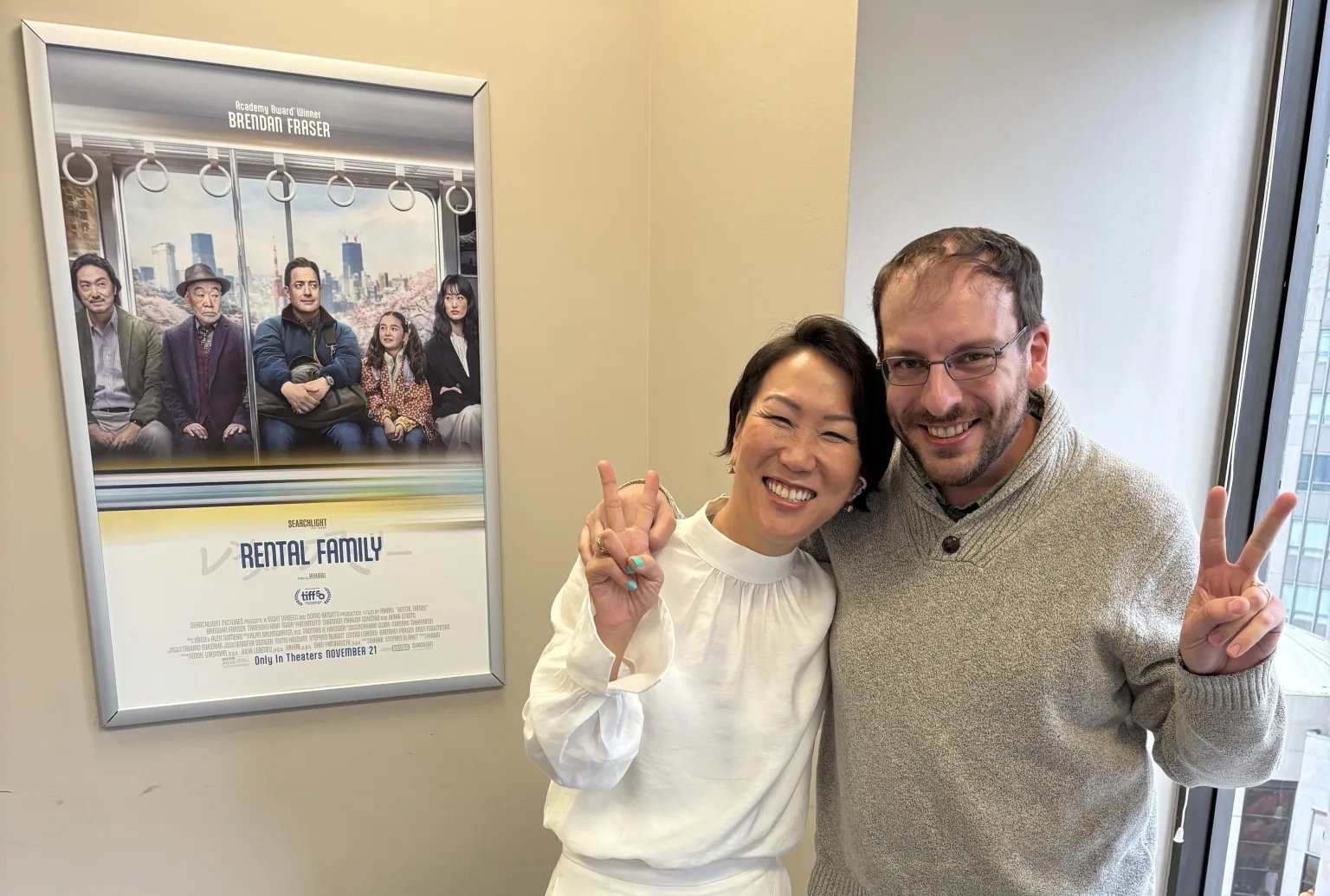
I am privileged to have Cinema Femme, the site created by my wife, as a platform where I can champion the work of storytellers whose brilliance deserves to be spotlighted. With the exception of Crispin Glover, whom I spoke with for my own blog last October, each of the people quoted below I had the honor of interviewing for Cinema Femme throughout the past eleven months. Though I rarely take pictures with an interview subject unless I am invited to do so, there were two conversations I had during last year’s Chicago International Film Festival that were so joyous, I couldn’t resist posing for a snapshot with the filmmaker afterward. The first can be seen above, from my chat with the amazing Hikari, whose 2019 debut feature, “37 Seconds,” I cannot recommend highly enough. The other you will hear more about below.
Click on each bolded name, and you will be directed to the full conversation…
“When you’re able to listen to yourself and follow your guidance, wherever it will take you will be the right answer. And once you get there, you’re going to start loving yourself even more. I honestly believe that. You can’t love somebody else when you don’t love yourself. Conveying this to people is the reason why I made this movie. I want people to know that they’re not alone. They are surrounded by so many other people who feel the same way. We just have to be open-minded about connecting with one another little by little, step by step.”—Hikari, director of “Rental Family”
“I could feel in my own life that any sort of comparison or even competition that I felt or didn’t want to own up to in myself but was there with another woman was like the upper crust of longing. Either it was my expression of a longing for a connection with this woman, or she’s expressing something that I’ve disowned in myself, and I’m sulking about it. I could sense that there was love, actually, right behind that competitive feeling. It’s interesting to talk about it now because I don’t feel it so much anymore. I think the film really did kind of alchemize something for me.”—Arabella Oz, co-director/star of “Mallory’s Ghost”
“I always felt that I have multiple identities that are informed by what is important to me. I cannot focus on one aspect of movie making or one aspect of being a citizen. My citizenship cannot be separated from my humanity. In such difficult times, everything becomes political. At the same time, it is so easy to take sides, and that polarization is dangerous because it kills any chance for a real debate. Cinema at its most courageous and respectful provides one of the last spaces in which having a dialogue is possible.”—Agnieszka Holland, director of “Franz”
“I was upset when I made the film, and I still am. I developed the story with my cinematographer Sarah Whelden and production designer Kelly Wilcox, both of whom also helped me produce this. Sarah’s trans, and there were times when we’d be like, ‘Am I going to have to leave the country?’ I still very much feel that way, but it was a really good distraction for us to pour ourselves into this project.”—Jessica Barr, director of “The Plan”
“Jess and I are the same age, and what I liked about her script was that it just felt so true to what our generation feels right now—this absolute desperation and total hopelessness, two polar opposite feelings existing at once. Someone has to do something, but it feels like there’s nothing we can do. The fact these characters are low-key the worst people for this job was funny to me, but I liked how they sort of come to terms with their desperation meeting that sort of hopelessness.”—Ryan Simpkins, star of “The Plan”
“I’ve had an anxiety disorder since I was a teenager, and we know that with certain neurodivergence, there is comfort in compression. I love bear hugs and weighted blankets. Some people like to be hugged lightly, but for people like me, a light hug is almost painful to my nervous system. I need a secure touch. Whereas some people like a very gentle, relaxing massage, other people really need you to be standing on their back. I’m a deep muscle person. It’s all informed by how we take in sensation, how we receive it and how we move it through our bodies.”—Madison Young, director of “By the Roots”
“I think the reason that the film is about an ugly cry is because it is this thing that should be pure and vulnerable and emotional and present. To be judged for not looking a certain way or having an eyebrow twitching when you’re trying to be vulnerable and connected is so sad. It shows the multiple things weighing on actors. I’ve been really lucky that I have not felt pressure to exist in a certain way. On ‘Transparent,’ I was a teenager and would have zits. The makeup team would try to help me cover them up, and Joey Soloway would come in and be like, ‘Why are you covering up Emily’s zits? Take the makeup off, we need those on camera!’ I really appreciated that.”—Emily Robinson, director/star of “Ugly Cry”
“I am inspired by how there seems to be a very strong connection between the ocean and moving between worlds in [Maya Deren’s] work. […] As young women, we’re often put into situations that are impossible for us to understand in a normal plane of existence. We need to access some sort of other feeling in order to escape them and transcend the trauma. That was where I went with ‘Hickey.’ ‘Quaker’ is a much more grounded film, but it does talk about that feeling of wanting to disappear—not die, but to kind of cease to exist in the current moment. For ‘Kismet,’ there is a direct water connection where the main character basically becomes an alien after she goes into the ocean, which is actually a portal. […] Because I spent a lot of time swimming in the ocean as a kid, I really associate it with a sense of freedom.”—Giovanna Molina, director of “Quaker”
“I don’t even know how to put it into words what it took for me to have that conversation with my mother about the fact that I needed help. My hesitation was due to the fear I had that I would get the response from her that I ultimately got. When your own mother doesn’t believe you, who do you go to next? What I hope that my story will do—by sharing it through this film—is it will reach those people in similar situations. I hope it will open up the eyes of parents, so that when their child does come to them for help, they will hear them. Sometimes their child won’t talk to them, but parents can still keep their eyes open and look for the signs that their child is trying to give them.”—Christy Salters Martin, subject of “Christy”
“You have been so intuitive in a lot of your questions in how you’ve recognized the ways in which Mirrah and David did not turn Christy into a stereotypical victim of domestic violence. They didn’t change who she was by making her a shrinking violet. No one would’ve believed that Christy would say something like, ‘Okay, Jim, whatever you want.’ They make her that same in-your-face girl that she has always been. And yet, she was still abused. I think that’s huge, and it’s believable.”—Lisa Holewyne, subject of “Christy”
“I come from a visual art background, so to a certain extent, the time lapses spring from my experience in video installation, sculpture and photography. As an archivist, there’s this compulsion to see time unfold, and all of those time lapses in the film were done in our yard. They’re capturing the passage of time, seasons, nature, but in a way, I kind of conceptualized the whole film as a time lapse. You’re watching essentially 21 years of a person’s life go by in an hour and a half, which results in a condensing of time from a single perspective, just like a time lapse.”—Amy Jenkins, director of “Adam’s Apple”
“My most direct involvement with the film over the past few years was in the writing process, so I didn’t always see the time lapses. I’m very interested in nature and in how I perceive myself in nature. I grew up in a very natural area with a lot of woods and not very much urban environment at all. Watching the time lapses in the film alongside myself growing and transitioning sends a message, which is that this is all just natural. My identity is as natural as the passage of time, the seasons and the blooming of flowers. I am a part of the world in the way that I am, in my gender identity, and we all unfold together.”—Adam Sieswerda, subject of “Adam’s Apple”
“I think [Marion Cotillard] was the perfect person to embody Cristina as well as the Queen because she is so beautiful. She is like a feminine ideal, but at the same time, she is complex. I don’t know her so much as a person, but she can be very classical in her appearance and very modern in the way she acts. I like that combination. I knew that she could be distant and cold, but I hadn’t seen her be scary very much onscreen, and I thought that would be an interesting thing for her to play. There are moments in the film where she is quite scary because you’re not sure what she is thinking.”—Lucile Hadžihalilović, director of “The Ice Tower”
“I’ve gathered enough from directors over the years to know for myself, from my own experience, what worked, what felt good and what didn’t. For a seven-year-old like Lexi, I wanted to keep it magical. If I was shooting a heavy scene, I wouldn’t tell her what was coming. I’d have both cameras on her—a very tight close-up and a medium shot—and I would just let all hell break loose and capture her face in the midst of it. I’d capture her in moments where she didn’t know she was being filmed, and later, I would stitch it together with the voice over, because a certain kind of self-consciousness just naturally creeps in if a kid learns a line or a scene over and over. So I kept it very natural, very free, and then just kind of stitched it with a needle and thread at the end.”—Embeth Davidtz, director/co-star of “Don’t Let’s Go to the Dogs Tonight”
“I think it is absolutely our job to just plain be present, especially when you are taking part in something that someone else is directing and has written and all of that. There is so much that is out of our control. All we can really control is giving a hundred percent of ourselves and doing the work in advance so that we can be fully present. Hopefully you have teammates and a director that you feel like you can have that safe space with to just fly.”—Alicia Witt, star of “Longlegs”
“I don’t like to say too much about the film because I want people to be open to interpreting it in different ways. I love surrealism—‘capital S’ surrealism, meaning the surrealists of the ’20s and ’30s, and ‘small s’ surrealism, which is contemporary surrealism. But because I’m aware of it and I always admire it, I recognize that there are ways in which my film is constructed—and even, I’ll admit, mistakes in my initial way of identifying the characters—that has led to confusion. Then I realized how these mistakes could be beneficial if I leaned into them. The storyline is hyper-clear to me, even in its poetic interpretation onscreen, but there’s no way anyone else could view it that clearly. My hope is that audiences will get something from the film, put it together in their own way, and have some kind of genuine experience with it.”—Crispin Glover, director/co-star of “No! YOU’RE WRONG. Or: Spooky Action at a Distance”
“I think the book also makes people like you and me feel less alone. How many people are really open to trying to think about this? In a world like we’re living in, which is so troubled and there’s so much fear, people tend to want everything to stand still. They will do anything to seek out fiction that tells them, ‘You are here.’ But there are loads of people like us who want to work out these feelings that we’ve had that we didn’t know how to express until we discovered these artists. I hear a lot of people who are artists and critics saying, ‘I want people to feel less alone.’ That is my hope.”—Martha P. Nochimson, author of Quantum Screens: Nonlinear Universes in Film and Television
In addition to writing the above interviews, I had the honor of serving as the assistant coordinator for the final installment of Ebertfest, the annual film festival held at Roger Ebert’s alma mater in Champaign, Illinois, which became yet another casualty of the president’s efforts to defund universities, especially those that value diversity and empathy. A few minutes prior to this year’s very final screening—Rob Reiner’s “The American President”—my former boss and eternal friend Chaz Ebert called me from backstage and asked if I would deliver the intro for it. Though I had typed up a sheet of notes in case I was asked to participate in a Q&A afterward, I had no speech prepared. But as I walked out onstage and gave Chaz a hug, I suddenly felt overcome with the calmness I had back when I performed plays in high school. I had done all the preparation and now needed only to rely on my instincts. You can watch my intro at the 10:30 mark in the video embedded above.
Having Rebecca join me for the last Ebertfest in April felt especially fitting, since a few months prior, she had brought me along with her Cinema Femme team to experience the Sundance Film Festival during its final year in Park City. All the extraordinary experiences I had there—including an extended meditation session with Chloé Zhao—can be found in this essay. Just days before it received a rapturous at Berlinale, I was invited to attend a sneak preview of Kelly O’Sullivan and Alex Thompson’s new feature, “Mouse,” which is still the best narrative feature I have seen so far this year (read my review here and keep your eyes peeled for the film this fall). A day before I turned 40, I shared on Indie Outlook my favorite film lists for every year over the past century, while I was able to compile with relative ease thanks to Letterboxd.
Last year, I also found time to review Colin Hanks’ lovely documentary, “John Candy: I Like Me,” following its Chicago premiere; honor the legacy of “Siskel & Ebert” as the show celebrated its fiftieth anniversary last year; and rank my Top 20 Films of 2025 while singling out who I’d nominate in each awards season category. Perhaps no single moment over the past year of interviews thrilled me more than when I got to ask the legendary Polish director Agnieszka Holland about her experience of helming 1993’s masterful screen version of “The Secret Garden,” which remains one of a handful of pictures that never cease in moving me to tears. You will find her response below our picture…
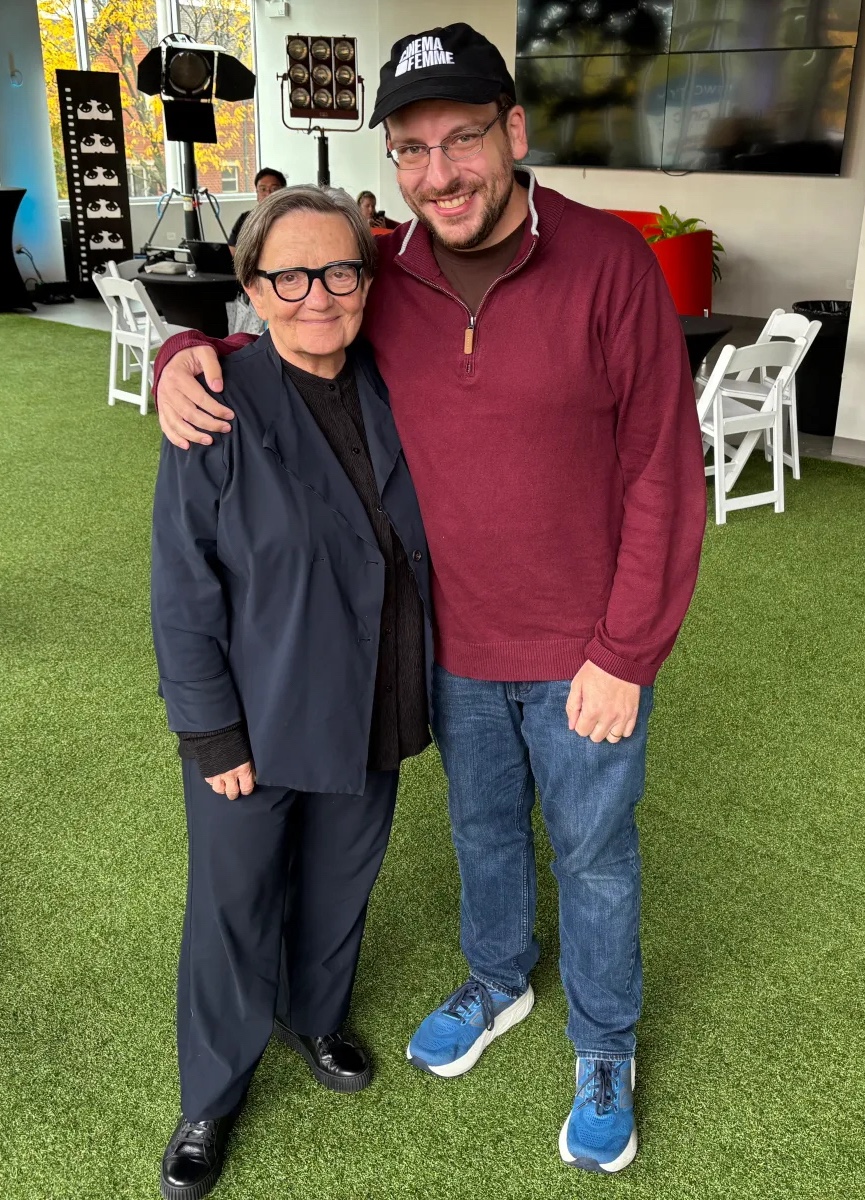
“The experience was terrible. I’m proud of the film, but the process was very painful. It was a lot of pressure. The film wasn’t what the studio had expected. They imagined it to be some kind of Disney movie, but it was much darker and different, so it was difficult. The experience also triggered some allergies in me. I got a terrible allergy from seafood I ate during the shoot, which stayed with me for 15 years. And I think, in reality, it was my allergy for big American studios. I had to fight for my vision of the film in different ways than I was used to. I didn’t want the film to be sugar-coated. It should be real, and dark when it needs to be. The emotions should be sincere and not manipulated by pushing too hard, which happens quite often. But I cannot complain. I watched the film a few years ago on a plane because somebody was watching it and I thought, ‘Wow, if it is in the library, I will check on it.’ So I started to watch it and I couldn’t stop. By the end, I was crying. I became the ordinary viewer.”
For the first volume of my Cinema Femme retrospective, click here. To purchase a monthly or annual subscription to Cinema Femme, click here.

