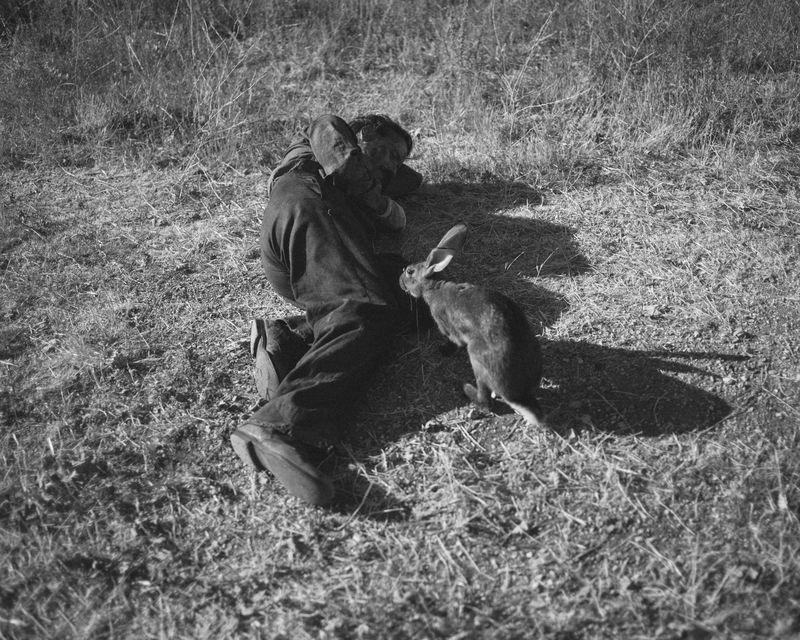
It may sound strange for me to call a film as unsettling as Jared Hogan’s debut feature, “Jackrabbit,” therapeutic. But in an era of nonstop sensory overload, it’s a great relief to find a work of art that invites us to slow down—much like “Twin Peaks: The Return” did—and pay attention to the details that, when overlooked, could result in a fatal error. That is the precise effect Hogan’s mesmerizing film had on me from its first frame onward. One of my favorite character actors, Frank Mosley, anchors the picture as T.A. Diamond, a coal miner who can’t bring himself to inform his wife and children about his sudden work injury. Filled with anxiety, he wanders through the unforgiving landscape of Utah circa 1930, becoming as increasingly jumpy as—well, the titular animal.
On the heels of lensing Kristen Stewart’s own brilliant directorial debut feature, “The Chronology of Water,” cinematographer Corey C. Waters gives us one striking image after another, while composer Michael A. Muller and Hogan’s sound team burrow deeply within the psyche of Mosley’s character, who can speak volumes with a single glance. It must be noted that Muller previously collaborated with Hogan on the galvanizing 2023 short “How to Make a Ghost,” which makes an unexpectedly fitting double bill with the director’s music video for the Gracie Abrams track, “The Bottom.”
Upon its world premiere this past September at the Oldenburg International Film Festival in Germany, “Jackrabbit” received its first festival prize, the Seymour Cassel Award for Outstanding Performance, which was deservedly given to Mosley. Prior to the picture’s upcoming screening in Greece, I had the pleasure of speaking via Zoom with Hogan, Mosley and Waters about their collaboration, which demands to be experienced—like “Chronology of Water”—on the biggest screen possible.
How did the three of you first begin working together?
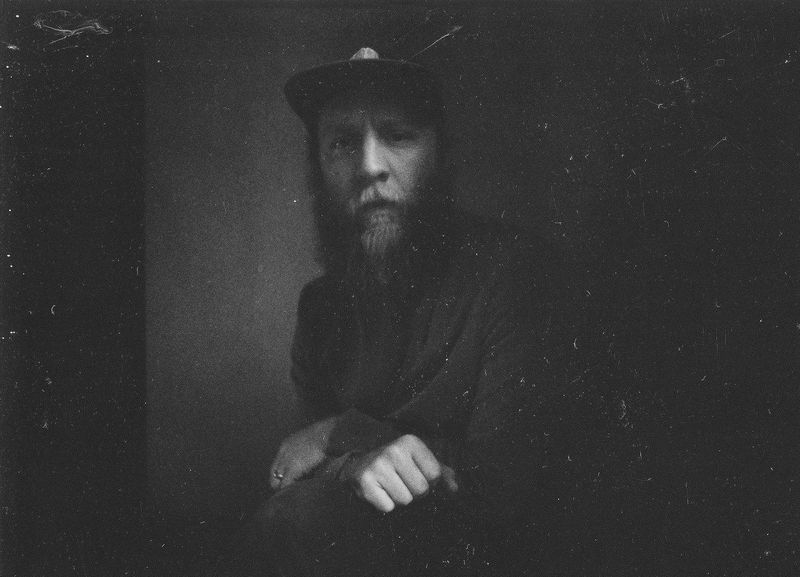
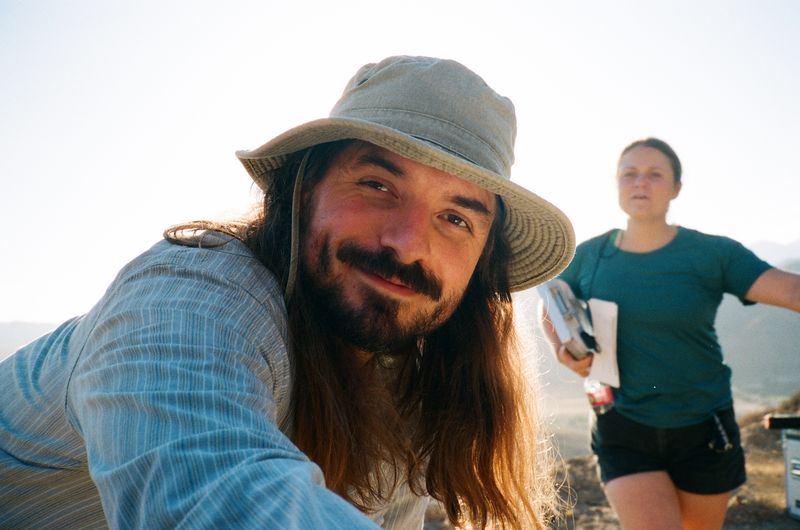
Jared Hogan (JH): I had written a script that I thought was going to be my first film. I sent it out to everyone and all I heard back were crickets. Corey was over, and we were looking at a photo book I had in my office. That’s when I was like, “Dude, let’s fucking go somewhere for a week with a camera and just shoot something. And we should get Frank to come out.”
Frank Mosley (FM): After seeing “How to Make a Ghost,” I basically slipped into Jared’s DMs and asked, “Hey, you want to work together?” As an actor, you are oftentimes not in control. Things are given to you or you audition for things that are around, but when I work with these guys, I’m getting to act in a movie that I like to see, and that’s a gift. Because we share a love of filmmakers like Bresson, we speak the same language onset, and whether I’m on one side of the camera or the other, it doesn’t matter. I’m in it because I love that kind of style. The horror short we made, “Dogbite,” proved to be a testing ground for all that.
JH: We talk about it as a precursor to our feature, but that was never the plan. We just went and shot for four or five days in Lancaster, outside of LA, in late 2024 with no money, no script, no locations. We were just making it up as we went along, and followed what we found to be interesting.
FM: Two other actors came to join us, including Hannah Alline, who produced “Jackrabbit.” Jared’s so good at conjuring up dread in a short film form, so based on our experience of having so much fun, he asked if I would take on the lead role in his first feature. He told me that this was something he had been wanting to make for so long, and it had kept changing forms.
Corey C. Waters (CW): It’s not the sort of film that you get to make very often. What was most likely to get butts in the seats was never a part of the conversation. It was only about what the most interesting version of the story would be, and then figuring out how to go as hard as we possibly could in that direction. Jared is committed to finding the truth in that. He and I are so interested in the psychology of where to put the camera.
JH: I feel like I learned a lot from the limitations of the little town where I grew up. Even in film school, it was tough for me to find people who could really live in front of the camera. So for me, it became a lot more about what the camera can say when it’s pointed in a certain direction for a period of time. As my career has progressed, I’ve been able to get more talented people in front of the camera. I remember reading about how Bresson would refer to his actors as models that he would move around, and I had never felt more seen than when I realized that I wasn’t alone in that.
I love actors and performances, but it’s all kind of within the frame—what they’re doing in it and how they’re populating it or moving in and out of it. I learned how to speak visually as opposed to trusting a monologue. When I’ve done music videos, of course the song is expressive, but I like to find visual ways to at times contradict the vibe and the point of the song as well as agree with it too. I had just gotten to a point where I was ready to tell a longer story, and it felt natural to me. I don’t really write with themes in mind, but when you work on a big story for a long time, it is kind of amazing the patterns that you see emerge, whether it’s in the edit or the production or how we shot it.
I can’t remember the last time that the height of a letter in an opening title scroll unnerved me.
JH: We originally had that first shot in “Jackrabbit” devised pretty differently. It was a similar concept, but sometimes a location will lead you to reconceive your approach. This was a 28-page script, so it was specific in some ways but open in other ways, and the whole pre-title prologue was something that came in post. We were editing every night after we shot, so we had a very solid assembly on our final day of production. Once I got back home and started to work with it, the timing and pacing of the credits all came together. I was very weary of “Jackrabbit” feeling like a period film, so from the beginning when I was working with my designer, we tried to find ways to make it feel more contemporary but also of the time in some strange way. Frank and I joke about how it feels like we made a 1970s movie about the 30s, which was kind of the goal.
“The Chronology of Water” was my wife’s favorite film last year and she tried mightily to get it shown on the best screen in Chicago, the Music Box Theatre. But we were fortunate to see it up close at Facets, and the experience was infinitely superior to viewing it on a laptop. I have no doubt the same could be said of “Jackrabbit.” How would you compare those experiences of working with filmmakers who are seeking to break the form by working outside of the traditional narrative?
CW: A lot of the directors I work with are allergic to making a film in the way that you’re “supposed to do it.” They’ll sense what the standard way is of doing something and want to flip it on its head. If the camera is doing a slow push-in on an emotional scene, we are probably doing something wrong because that’s the knee-jerk approach, often accompanied by violins. In the same way as Jared, Kristen likes to put a barrier between making something directly visible. How do we challenge the eye a little bit to find the thing that is most important in the frame? The journey to finding that is what makes the cinematic experience powerful in terms of the films that I get really drawn to.
The pace of “Jackrabbit” really challenges the viewer to be patient with us. We are all so interested in the legacy of slow cinema, but it’s also kind of a reaction to where we are today, with all the scrolling and swiping and short form content. “Chronology” was a bit different in that it was an homage to Lidia Yuknavitch’s book, which is fractured and fragmented in that Infinite Jest kind of way. You’re bouncing around so much that you may lose track of where you are at times, and that was another kind of language that we were interested in. How do we make the camera feel like it is hanging on a thread, as if it may hit somebody? It’s almost like an intentional interference, which is an interesting thing to play with, because everything is so often handed to us. In commercial filmmaking, there is no ambiguity and no question as to what happened in a given scene.
I like getting in the way of those things by putting the camera in a position where you sometimes have to hear the full picture. Even in the opening frame of this film, you get the sense that you’re in the characters’ home, but there is so much more beyond it that you only see through a little slice. As the viewer, you’re settling in and just letting it happen upon you, letting it live. When we finally do get to see the fullness of what we’ve glimpsed in that little sliver of the frame, the film expands in a really nice way. We prefer a more squared frame because when you put something at the bottom of it, then you back up and find that there is so much more space above it to look at.
FM: When there is that cut to me walking up the hill after all of those tight interiors, I felt myself kind of taking a breath upon seeing it at Oldenburg, because you’re just outside in air.
CW: That shot from behind of you walking up the hill was the first thing we filmed, and it was really tough. The camera was probably in the neighborhood of 50 pounds with the rig and everything else that the Steadicam operator had strapped to him. Frank was walking up a service trail that was pretty steep, so there were times when the ground would give out beneath you. It was important to Jared and I that a certain amount of negative space was maintained around Frank in the frame, so the operator had to be mindful of this while dealing with all the elevation changes inherent in walking up that hill. And since the shot takes place as T.A. arrives at work just before the sun comes up, the light had to be really specific. If we hadn’t nailed it, we would’ve had to try again the next day, but thankfully, we got it on day one.
I went back and looked at my interview from 11 years ago with Frank about his wonderful film, “Her Wilderness,” and was struck by him saying, “As an actor, I’m like, ‘If you want to shoot this whole scene with just the back of my character’s head visible because it’s true to your vision and style, then that’s great.’ It’s not about ego, it’s about being a paint for the canvas and being used however is needed.” There are a lot of shots like that in this film—and “Chronology of Water”—that have immense power.
CW: When we’re behind the character, and we can see what they’re seeing but not their facial reaction to it, I feel like that’s the closest you can get to experiencing a character’s POV, without the gimmick of having a hand come from out of frame to represent the character’s own. I feel like our approach puts you right there on that same path with T.A., and because the shot lasts for so long, you are picking up on all these micro details in his body language, like a little limp or head tilt. You are invited to fill in the gaps by engaging with the mystery of what you’re seeing, which gets your imagination going.
FM: The audience is the other half of my performance, based on where the camera is at, because there is so much that is obfuscated. What is left out of the frame makes you work harder in a creative way as a viewer but also as an actor, because it makes me think, ‘Is what I’m doing coming across when you only see my hand?’ It’s a puzzle that I really love. If you can get something across using as few resources as possible, and still make a banger out of it, that makes me happy. There is nothing sexier than minimalism.
But then there are moments where Jared will simply have the audience watch me eat for several minutes, and it becomes anthropological. It felt like being in a documentary, I’d say, ninety percent of the time because the takes were so long and I was just living the life of T.A. Diamond. So I would just eat or I would be with my wife or my kid, and I wouldn’t know if it would be in the film or not. Sometimes I wasn’t even sure if they were rolling, but I was existing, and that was a very rare thing to have as an actor.
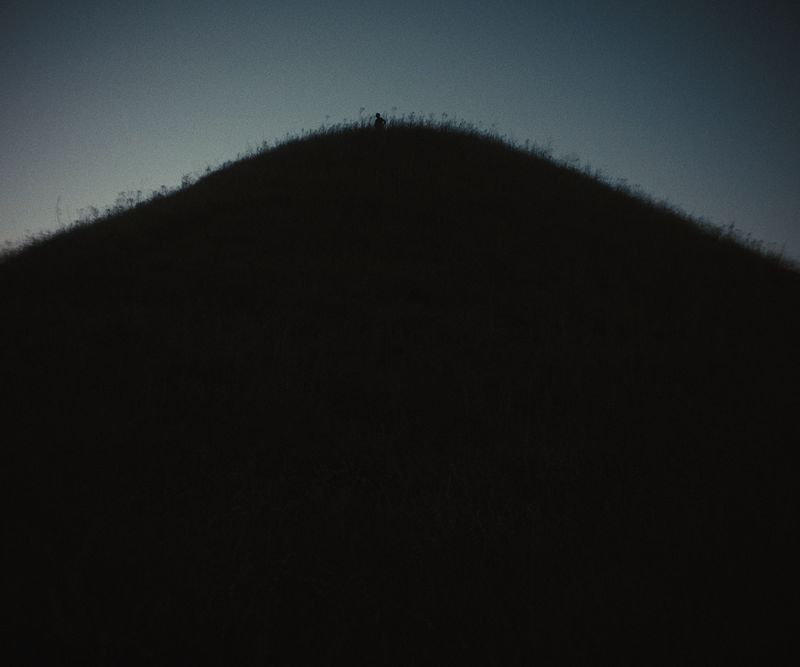
I must ask about the shot that holds on a silhouette of a hill as the sunlight slowly sinks beneath it and Frank is the speck wandering on top of it. The shot runs for so long that the viewer loses any sense of time.
JH: I’m trying to conquer this, but writing can sometimes feel like a bit of an obstacle for me, like it’s the thing that’s keeping me from being onset doing what I love to do the most. I was in the midst of writing the scene where Frank’s character realizes that he no longer has an opportunity to go home and he would have to brave the wilderness overnight. The idea of seeing the sun actually set made me so excited. It’s my favorite thing to watch with an audience in order to see the variety of reactions, including people walking out.
FM: We had three walkouts at Oldenburg, but I was just grinning the whole time.
JH: I take it as a badge of honor. It just felt right, which I put a lot of stock in personally.
CW: What I appreciate about you more than any other filmmaker I’ve worked with is your awareness of whether or not something is working. Your sense of that is operating at the highest level that I’ve ever experienced. You are so focused on the material and so connected to it that we end up wasting less time because you’ll immediately call out when it’s time to cut.
I’d love to hone in on the isolated moment of warmth Frank has with his children when he’s miming smoking a cigarette.
JH: I’d love to talk about that because it was one of the more jaw-dropping moments of my career as a director. In the script, it says something to the effect of, “Frank’s character is joking to the side with his older daughter,” but there is no specification as to what he’s doing at all. So I leaned into Frank as we were getting ready for the scene, and said, “I’m just trusting you that you have something up your sleeve.” For whatever reason, when we filmed his close-up, there was no one else at the table. All the other family members were getting changed or getting into makeup. As Corey and I sat and watched Frank do this, I almost had to look over from the monitor to make sure there wasn’t anyone at the table. Frank just fully manhandled that scene by himself.
FM: If it didn’t work, I knew he would tell me. There was such an open dialogue between all of us. When we did that scene, I remember the one thing I thought of was, ‘This is a guy who doesn’t joke.’ Think of the guy in your life—like your grandpa—who is a stern character, and the one memory you have of when he tried to be funny. He’s not funny normally, so it’s almost weird because you’re thinking, ‘What the hell is grandpa doing right now?’ I thought it should be something physical, since this movie is not about words. A small part of me worried whether it would be too goofy, but when Jared was like, “It’s good,” then I knew we could move on.
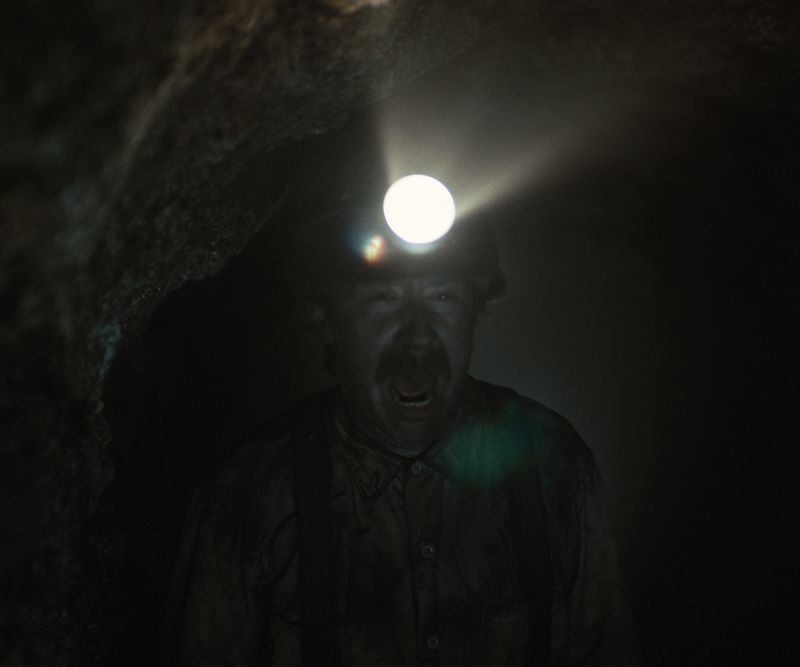
I feel “Jackrabbit” would make a fine double bill with “Her Wilderness” in how both pictures feel in a way like a subverted faerie tale for adults—certainly on the Grimm side—with as few scenes as possible that are each densely packed.
JH: I definitely feel like we, at times, ran the risk of giving the audience too little, but I’m someone who would rather err on that side. Even on the page, I find myself as I’m writing to be really skittish about explaining anything, like to a fault.
I have a feeling that when Lynch fans spot Robert Broski, the “Got a light?” guy from “Twin Peaks: The Return,” as the one of the miners, they’ll have a whole new interpretation of his character on the show.
JH: [laughs] When we saw his tape among the ones coming in, I was like, “No fucking way.” As soon as I saw his image, I knew immediately that we had to cast this guy. I didn’t really get a chance to talk with him. Did you, Frank?
FM: Barely. He was quiet and mysterious to me, and I didn’t want to ask for his signature or smoke around the guy.
The film builds to a moment that had an unnerving effect on me similar to the climax of “Blue Velvet.”
JH: We walked into this empty building that literally just consisted of four walls, and our production designer Mary Florence Brown, with very little resources, turned it into an incredibly lived-in and inhabited space where every single thing said so much. The film is designed on some level to set expectations that are broken. After following Frank through this outdoor landscape for so long, you enter this house with him that is unlike anything he’s encountered up to that point. We were excited to see how that sequence in the house would come to life and shake everything up.
CW: The camera is slowly moving through the space, so your eyes are taking the time to look at all the details in the frame, so when something suddenly makes a noise, you may not notice where it came from. When I watched the film during its first screening, I had forgotten about the noise, and it startled me. It plays on our built-in paranoia. That “Blue Velvet” reference is nice, and though we never spoke about Lynch’s work while making the film, he was all about doing the unexpected. I love when I am left with so many more questions. That’s what I crave in cinema or any kind of storytelling, which is why this was the dream film to be able to make.
FM: I’ve joked that T.A.’s day out begins when he first decides not to go home, and it’s like “Ferris Bueller’s Day Off” in 1930s Utah. Even though he’s going through something, he’s loving life before he goes into a dark spiral in the next act of the film. When he gets to that house, it’s still tense, but you also feel like there might be a silver lining for him there. It was fun to play with that sort of pivot.
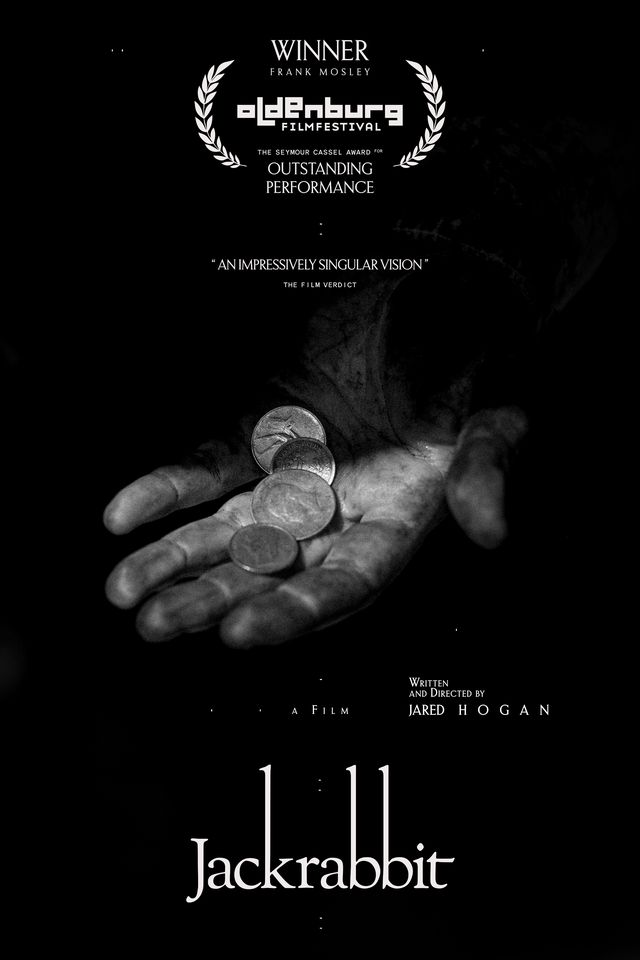
What was the experience like of having the film premiere at Oldenburg?
FM: A previous film of mine, “Some Beasts,” had made its international premiere there in 2016, and I couldn’t make it, so attending it this year really felt to me like making up for lost time. Every movie that screened there took a swing, and I appreciated their boldness. Amanda Plummer was on the jury, as was Deborah Unger, who is married to the festival director. When I won the festival’s acting prize, I almost started crying on my way to the stage. It really felt like a pat on the back after having been working for so long.
There is a coiled intensity in your performance that reminded me of Daniel Plainview in “There Will Be Blood,” and not just because of the mustache.
FM: That means so much to me. I’m just so used to being a supporting actor, which I love. “Jackrabbit” was my first lead role since “Some Beasts.” Maybe every ten years, I’ll get one of them. [laughs]
What are the release plans for the film?
JH: We are very much in the festival space right now. We did just land our next festival, which is Thessaloniki in Greece. It’s in a section that is very catered to this film, since it’s about the use of time within film, so that will be really cool. I’m not the guy who thinks everything has to be seen in a theater, but I do feel distinctly different about “Jackrabbit.” It is a must-see on a big screen, and I always kind of cringe about having people watching it on a screener. I don’t want it seen that way, but I also don’t have a good alternative. So whenever I send it out to someone, I always make sure to tell them, “Watch it in the darkest room at the highest volume.”
“Jackrabbit” screens at 7pm on Friday, November 13th, at the Thessaloniki International Film Festival in Greece. For more information on the film, visit its official site.

